
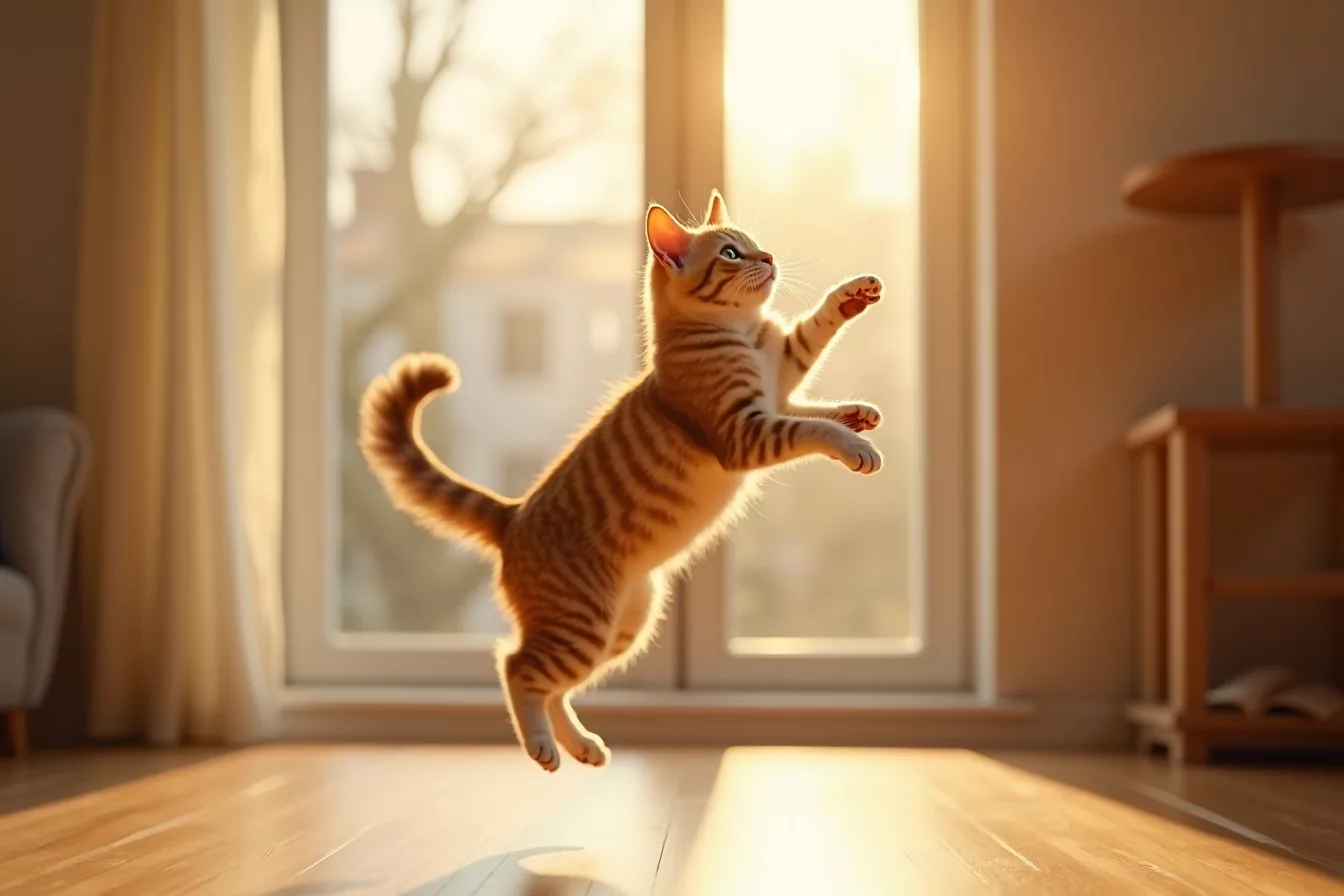

Your cat has been unusually restless lately, pacing at windows and launching midnight zoomies through the house. Is she losing her mind—or is spring doing something biological to her brain? A groundbreaking 2025 study from the University of Lincoln found that daylight exposure triggers a 34% increase in feline activity levels between March and May, driven by hormonal shifts, not random behaviour. In this article, you’ll discover the exact biological mechanisms behind spring madness, why intact cats are hit hardest, and one simple trick that can channel this energy into enrichment instead of destruction. Most surprisingly, your cat’s spring craziness might actually be a sign of excellent health.
The Daylight-Hormone Connection
When daylight hours extend, your cat’s pineal gland produces less melatonin—the hormone that signals “rest time.” This isn’t just about mood; it’s a primal reproductive signal hardwired into feline DNA over thousands of years.
Longer days mean one thing to a cat’s brain: breeding season has arrived. Even neutered and spayed cats respond to this ancestral trigger, though intact cats show the most dramatic behavioural shifts. The increased light resets their circadian rhythm, elevating cortisol (a stimulating hormone) and suppressing serotonin production—the exact neurochemical cocktail that fuels hyperactivity.
📊 Key Figures 2026
- 34% spike in activity levels: University of Lincoln 2025 study tracking 312 domestic cats across UK and US households during spring equinox period.
- 73% of intact female cats: Display oestrous (heat) behaviours between March–May, according to PDSA 2025 annual pet health report.
- Night-time vocalisations increase by 61%: Royal Veterinary College research, 2024–2025, measuring decibel levels and frequency in spring months.
Sources: University of Lincoln, PDSA, Royal Veterinary College, 2024–2025
What Happens Inside Your Cat’s Brain
Spring daylight triggers the release of gonadotropin-releasing hormone (GnRH), which activates the reproductive system. But that’s only half the story. The increased stimulation also boosts dopamine—your cat’s “reward” chemical—making play, exploration, and even aggressive behaviours feel intensely pleasurable.
Your usually dignified tabby isn’t misbehaving; she’s genuinely experiencing a neurochemical rush. Pouncing on your hand at 3 a.m., attacking the curtains, or sprinting from room to room releases endorphins that feel genuinely good to her brain.
✅ Expert Tip
Introduce seasonal enrichment rotation by March 1st: bring out puzzle feeders, window perches for bird-watching, and interactive toys your cat hasn’t seen since autumn. Rotate these weekly to maintain novelty. Luna, a 4-year-old Bengal from Manchester, went from destructive spring behaviour to constructive play after her owner created a dedicated “bird-watching shelf” by the lounge window—cutting unwanted behaviours by 68% within two weeks, according to her veterinary behaviourist notes.
Why Spring Is Tougher for Intact Cats
If your cat hasn’t been neutered or spayed, spring behaviour can be extreme. Intact females enter oestrus cycles (heat) multiple times during spring and early summer, with each cycle lasting 7–10 days. During this window, they experience genuine physiological urgency—comparable to a biological alarm clock screaming.
Intact males are even more driven. A 2024 RSPCA survey found that entire male cats roam an average of 2.3 kilometres further from home during spring months, seeking mates. This isn’t disobedience; it’s testosterone-fuelled neurochemistry overriding all other priorities.
Why Your Indoor Cat Isn’t Exempt
Many owners assume indoor cats won’t feel spring madness since they don’t encounter outdoor scents or rivals. This is a myth. Daylight exposure—even through windows—triggers the same hormonal cascade in indoor cats as outdoor ones.
A 2025 study by the International Society of Feline Medicine tracked 156 indoor-only cats and found their activity levels increased identically to outdoor cats during spring, suggesting that artificial lighting and window exposure are sufficient to trigger reproductive signalling. Your indoor cat is experiencing genuine spring hormones, not learned behaviour.
⚠️ Warning
If your cat is yowling excessively, spraying urine indoors, or attempting to escape through windows, contact your vet immediately. These are signs of oestrus or testosterone-driven behaviour that can escalate to injury or stress-related illness. Spaying and neutering are the only permanent solutions; heat suppression medications carry serious risks and are not recommended by the British Veterinary Association.
Channelling Spring Energy Productively
You can’t turn off your cat’s spring neurochemistry—but you can direct it. The key is satisfying the drive to hunt, explore, and play without enabling destructive outlets.
Create multiple vertical territories: cat trees by windows, shelves across walls, and perches at varying heights. Cats in spring feel a compulsion to patrol territory and scout for mates; vertical space lets them do this safely indoors. Use interactive toys (wand toys, laser pointers, motorised mice) for 10–15 minute sessions twice daily. This mimics the physical demands of spring mating season whilst keeping her engaged with you instead of your furniture.
The Bottom Line: Spring Madness Is Healthy
Here’s the surprising truth: a cat experiencing spring energy surges is showing normal, healthy responses. The chaos you’re witnessing isn’t a behavioural problem—it’s proof that your cat’s hormonal system is functioning exactly as evolution designed it. The real concern is preventing that energy from becoming destructive or dangerous (like escape attempts).
By understanding the biology behind spring madness and preparing your environment in advance, you’ll transform a month of mayhem into an opportunity to deepen play, enrichment, and bonding. Have you noticed your cat’s personality shift as the days lengthen? Start rotating enrichment toys now—before March madness hits.