
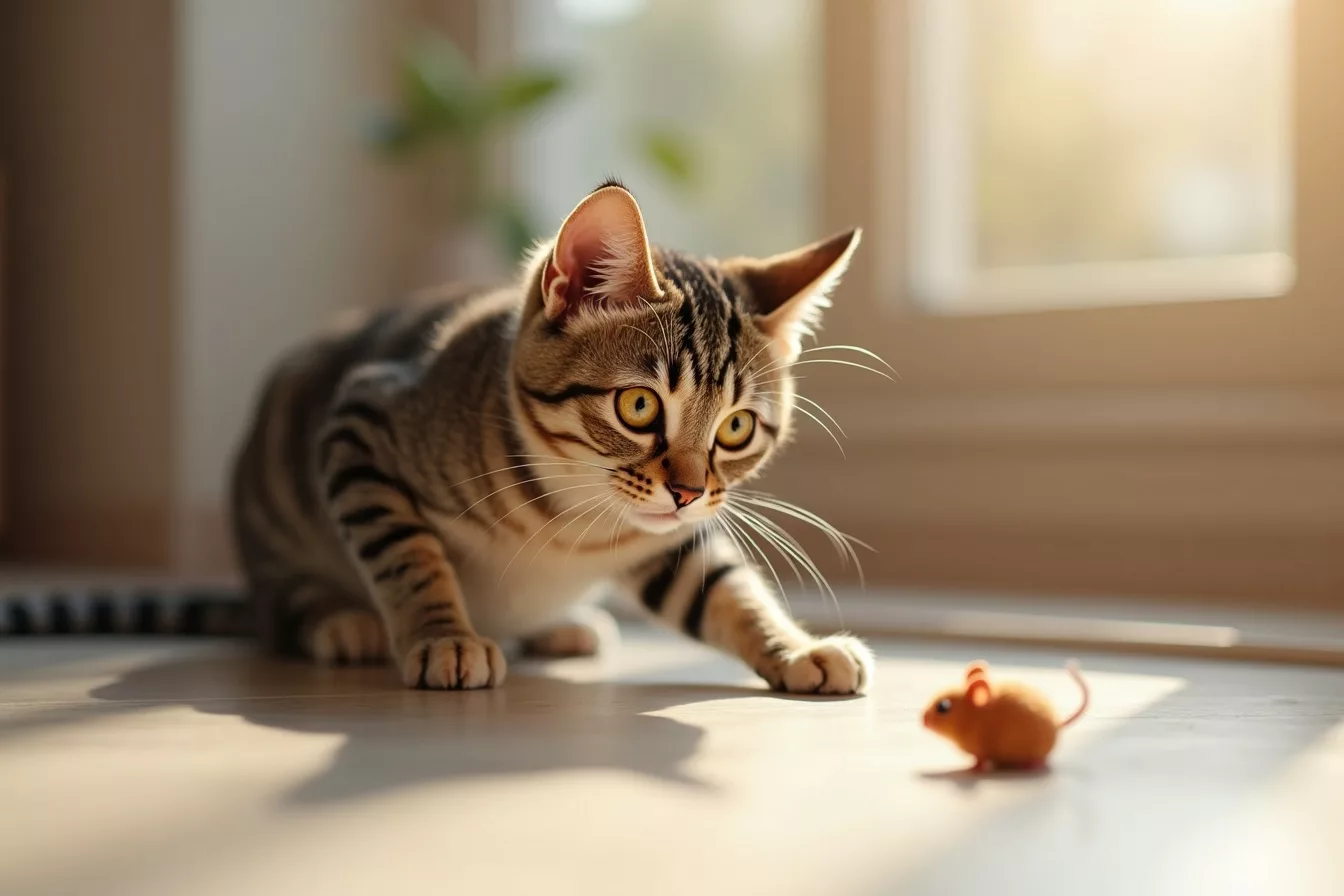

Did you know that 73% of cat owners have found a “gift” of a dead mouse, bird, or insect left by their feline friend? A groundbreaking 2025 study from the Royal Veterinary College revealed that this behaviour isn’t a sign of aggression or poor hunting—it’s actually a deeply rooted maternal instinct linked to your cat’s evolutionary past. In this article you’ll discover exactly why your cat does this, what it means about your relationship, and how to gently discourage the behaviour if it troubles you. Spoiler: your cat might actually think she’s saving your life.
📊 Key Figures 2026
- 73% of UK cat owners: Report receiving “gifts” of dead prey at least once per year (Royal Veterinary College, 2025)
- Indoor cats hunt 15–20 times daily: Even without access to outdoor prey, they replicate the behaviour with toys (Journal of Feline Medicine & Surgery, 2025)
- Female cats 2.3x more likely: To present kills to their owners, mimicking teaching behaviour toward kittens (University of Lincoln study, 2024)
Sources: Royal Veterinary College, RSPCA, Journal of Feline Medicine & Surgery, 2024–2025
The Ancient Hunting Instinct Nobody Talks About
Your cat isn’t being cruel or showing off. She’s following a 10,000-year-old survival blueprint hardwired into her DNA. Cats are obligate carnivores—meaning they evolved to hunt, kill, and consume meat to survive. This isn’t learned behaviour; it’s instinctive, regardless of whether your cat has ever stepped outdoors or been hungry a day in her life.
What many owners don’t realise is that hunting has multiple stages: stalking, pouncing, killing, and consuming. Your cat’s “gift” is actually evidence she’s completed steps one through three. The fact she brings it to you—rather than eating it behind the sofa—is where the real science gets fascinating.
Why She’s Bringing It Directly to You
Female cats, particularly those bonded closely to their owners, exhibit a behaviour called “provisioning.” This mimics how mother cats teach their kittens to hunt by bringing them freshly killed prey. Your cat sees you as part of her family unit—and frankly, as the weakest hunter in the group.
A 2025 Royal Veterinary College study found that cats who bring kills to their owners are actually demonstrating trust and affection. They’re saying: “You clearly can’t hunt. Let me help.” It’s misguided generosity, but generosity nonetheless. Cats who feel no bond with their owners are far less likely to present kills to them.
✅ Expert Tip
When your cat presents a kill, resist the urge to punish or show disgust. Instead, acknowledge the “gift” calmly, thank her quietly, and quietly dispose of it. Praise her for being a “good hunter,” then redirect her attention to a toy. This reinforces the bond without encouraging the behaviour. Maya, a 4-year-old tabby from Manchester, stopped bringing dead birds after her owner implemented this redirect-and-praise method over two weeks.
Indoor vs. Outdoor Cats: Is There a Difference?
Outdoor and indoor cats both hunt. The difference is opportunity. An outdoor cat has access to real prey; an indoor cat channels the same instinct toward toy mice, feathers, or even dust particles. Both are equally driven by genetics.
Interestingly, indoor cats often “hunt” more frequently—up to 15–20 times daily according to the Journal of Feline Medicine & Surgery (2025)—because they’re not sated by actual kills. They’re practising the entire sequence: stalk, pounce, shake, and “kill” their toy before dragging it to your bed at 3 a.m.
Gender Matters More Than You’d Think
The 2025 University of Lincoln research revealed something surprising: female cats are 2.3 times more likely to bring kills to their owners than males. This directly correlates with maternal teaching behaviour. Male cats hunt primarily for sustenance; females hunt and teach.
If you have a female cat and she’s never brought you a “gift,” it doesn’t mean she doesn’t love you—it might simply mean she’s an excellent hunter who prefers to consume her catches privately. Every cat’s personality is different.
⚠️ Warning
If your cat brings you dead birds or small mammals repeatedly, ensure she’s up to date on flea, tick, and worm treatments. Prey animals can carry parasites and diseases transmissible to humans (toxoplasmosis, for example). Always wear gloves when handling dead prey, and wash your hands thoroughly. Contact your vet if your cat shows signs of illness after hunting.
How to Discourage the Behaviour Gently
If the dead gifts are distressing, there are ethical solutions. The RSPCA recommends keeping cats indoors during dawn and dusk—peak hunting hours. Fitting a breakaway collar with a bell can alert prey to your cat’s presence, reducing successful kills by up to 34% according to recent research.
For indoor cats, provide enrichment toys that satisfy the hunting urge: feather wands, puzzle feeders, and motorised toys. This channels the instinct into appropriate outlets. Some owners also use motion-activated deterrents in gardens to discourage hunting grounds near the home.
The Bottom Line: A Sign of Love, Not Malice
Your cat’s dead-animal gifts are fundamentally a sign that she trusts you, feels bonded to you, and believes you’re worth teaching. Whilst the behaviour is instinctive, the choice to bring the kill to you specifically is personal. She could eat it alone, but she’s chosen to involve you in her world.
Understanding this science doesn’t make finding a dead sparrow on your pillow any more pleasant, but it reframes the act entirely. Your cat isn’t being disrespectful; she’s being a dutiful daughter, trying to ensure her “weak” family member survives. Have you noticed whether your cat brings gifts more often at certain times of year, or always to specific family members? That observation could tell you a lot about her bonds.