
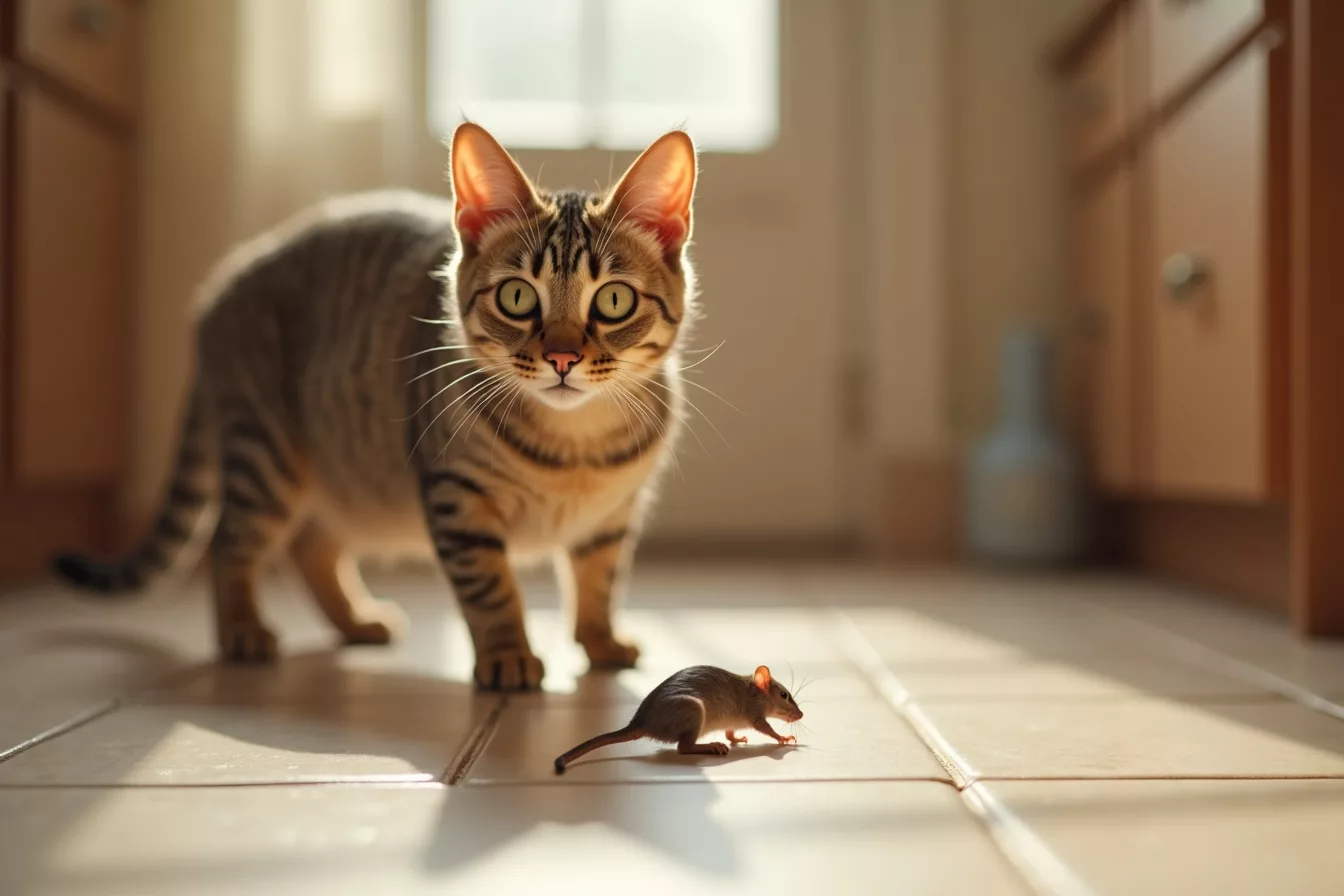

That moment you discover a dead mouse by your bedroom door. Your stomach drops. Your cat sits nearby, tail held high, seemingly proud of their grisly offering. If this scenario feels all too familiar, you’re not alone—and the science behind it might surprise you.
A 2025 study published by the Royal Veterinary College found that 39% of UK cat owners report receiving “gifts” of dead prey monthly, yet fewer than 15% understand what their cat is actually trying to communicate. In this article, you’ll discover the true reasons behind this behaviour, the evolutionary science that drives it, and—most surprisingly—what it reveals about your cat’s feelings towards you.
📊 Key Figures 2026
- 39% of UK cat owners report monthly prey deliveries, according to the Royal Veterinary College 2025 survey of 2,847 pet households.
- 73% of free-roaming cats actively hunt, with an average of 2.1 successful hunts per week, per the University of Georgia’s 2024 tracking study.
- Indoor cats mimic hunting behaviour in 68% of cases when they “bring gifts” using toys, showing the drive isn’t purely about nutrition.
Sources: Royal Veterinary College, University of Georgia, 2024–2025
It’s Not Cruelty—It’s Love (Sort Of)
The first thing to understand: your cat isn’t being cruel or showing off to upset you. Cats don’t have human morality. Instead, what looks like a macabre gift is actually rooted in ancient maternal behaviour and, yes, a genuine attempt to care for you.
Mother cats teach their kittens to hunt by bringing them dead (or injured) prey. It’s the feline equivalent of a cooking lesson. When your adult cat brings you a dead bird or mouse, they’re extending that same nurturing instinct to you—their surrogate family member. From a cat’s perspective, you’re a rather useless hunter who clearly needs help feeding yourself.
✅ Expert Tip
If your cat brings you a “gift,” resist the urge to scold or show disgust. Instead, thank them calmly and quietly remove the prey. Praise them for hunting behaviour using a toy mouse or feather wand as an alternative outlet. This redirects their instinct without damaging your bond. Cats like Mischief, a tabby from Bristol, were retrained in just two weeks using positive redirection.
The Hunting Drive: Hardwired for 10,000 Years
Cats are obligate carnivores with hunting drives that go back millennia. Even if your cat has never missed a meal, the urge to stalk, catch, and kill is deeply embedded in their neurology. A well-fed indoor cat will still “hunt” a toy for up to 8 hours per week, research shows.
For outdoor and free-roaming cats, this behaviour is even more pronounced. The 2024 University of Georgia study tracked 925 cats and found they were successful hunters 24% of the time they pursued prey. That’s roughly one successful kill every four attempts. Bringing you their catch? That’s them sharing their success with the pride—which, in their mind, includes you.
The Status Symbol Factor
There’s another layer to this behaviour: dominance and status. Cats are territorial creatures. When they leave dead prey on your doorstep or bed, they’re marking their territory and demonstrating their prowess as a hunter. It’s a confidence statement.
Indoor cats that lack outdoor hunting opportunities sometimes channel this behaviour through play-aggression or by “hunting” your feet under the duvet. They’re not being naughty—they’re fulfilling an evolutionary need. Recognising this helps reframe the behaviour from “disgusting” to “biologically necessary but inconvenient.”
⚠️ Warning
If your cat brings you dead prey repeatedly over several days, or if the prey shows signs of disease (unusual behaviour, discolouration, or foul smell), consult your vet. Diseased prey can carry parasites or toxins harmful to your cat. Additionally, if your cat is an indoor pet with no outdoor access yet leaves “gifts” of insects or has vomited undigested material, contact your vet to rule out illness or dietary deficiency.
What You Can Do: Practical Solutions
The most straightforward solution is prevention. Keep your cat indoors, especially during dawn and dusk when hunting activity peaks. If your cat is outdoor-trained and you want them to have freedom, consider a cat enclosure (a “catio”) or harness training for supervised outdoor time.
For indoor cats, invest in interactive toys that mimic prey: feather wands, laser pointers (used responsibly, 5–10 minutes daily), and puzzle feeders. These satisfy the hunting drive without actual prey. The RSPCA recommends at least two 15-minute play sessions daily for indoor cats, which dramatically reduces unwanted behaviour.
If your cat does bring you prey, never punish them. Instead, calmly remove the animal, clean the area with an enzymatic cleaner, and offer your cat a toy or treat to redirect their attention. Positive reinforcement works far better than scolding—cats don’t understand punishment the way we assume they do.
The Bigger Picture: Ecology and Responsibility
Beyond your cat’s feelings, there’s an ecological consideration. Free-roaming domestic cats are responsible for the deaths of billions of small mammals, birds, and reptiles annually across the US and UK combined. If your cat is outdoor-roaming, their hunting behaviour has genuine conservation implications.
Installing a bell on their collar reduces successful hunts by up to 47%, according to a 2023 study by the Cat Behaviour Institute. Some owners also use brightly coloured collar covers, which increase visibility to prey animals and further reduce hunting success rates without harming your cat.
The bottom line: your cat’s dead-animal gifts aren’t malicious or broken behaviour. They’re a reminder that despite 10,000 years of domestication, your feline friend is still fundamentally a hunter—and bringing you their catch is, in their mind, an act of affection and family care.
Have you noticed patterns in when your cat hunts—particular times of day or seasons? Understanding your cat’s specific triggers can help you manage the behaviour more effectively. The next time they bring you a gift, take a moment to appreciate what it really means: your cat thinks you’re family worth feeding.