
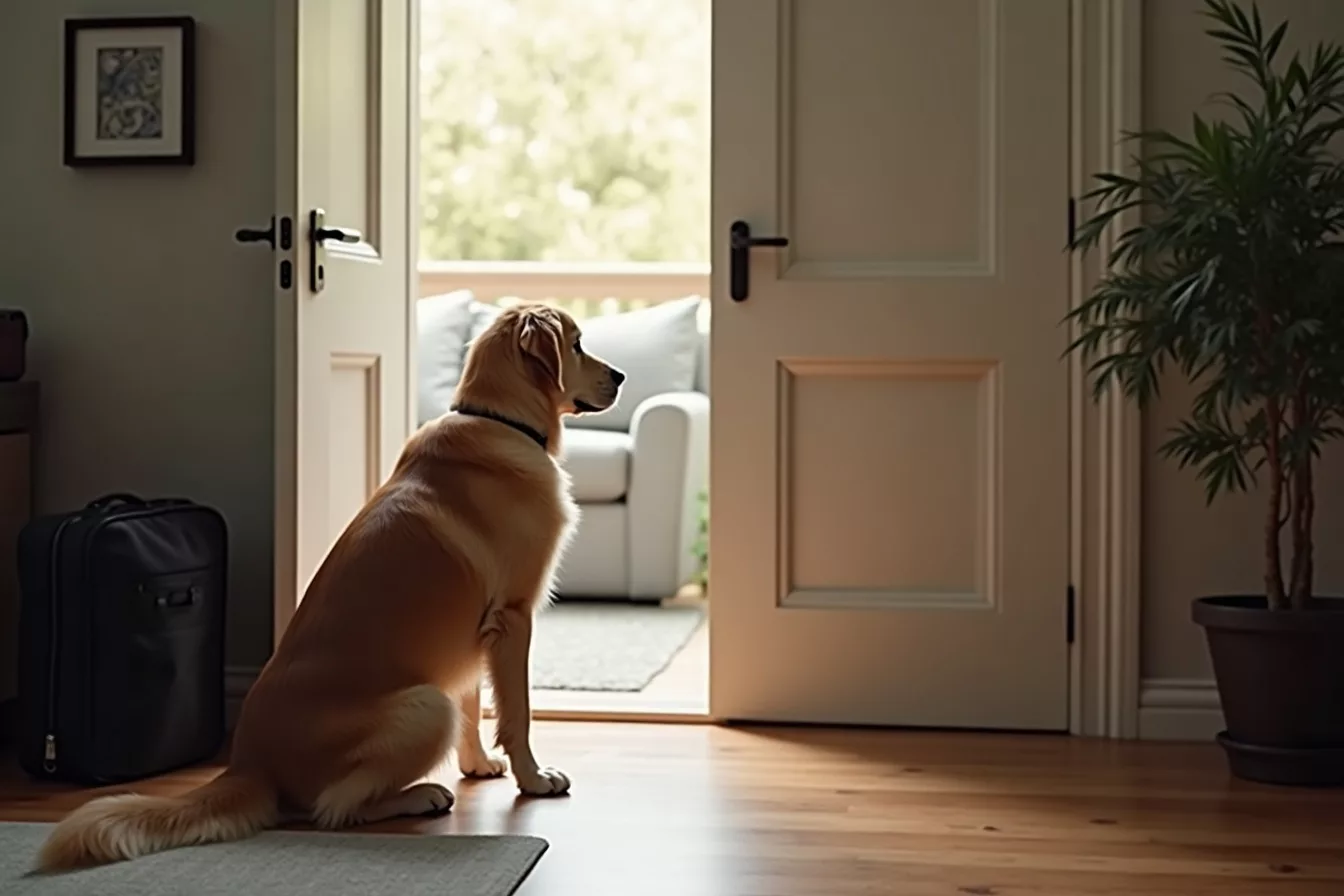

What if your decision to work from home has permanently changed your pet’s behaviour? A shocking 2025 PDSA study reveals that since the pandemic, 68% of UK pet owners report lasting behavioural changes in their animals—and many of those changes are here to stay. In this article you’ll discover what the research actually shows, why vets are concerned, and the one simple habit that could have prevented it all. Spoiler: it’s not what you’d expect.
For the past five years, millions of UK and US pet owners have enjoyed the luxury of being home all day. Dogs got extra walks. Cats received constant attention. Rabbits had their humans nearby during crucial bonding hours. But now, as hybrid working and office returns become the norm, something unexpected is happening: our pets are struggling to cope.
The PDSA’s latest research—one of the most comprehensive pet behaviour studies of 2025—has uncovered a troubling trend. Pets that spent their formative years with constant human presence have developed dependency behaviours that are proving resistant to change. Even as owners gradually return to offices, their animals are showing signs of genuine distress.
📊 Key Figures 2025
- 68% of UK pet owners: Report permanent behavioural changes since remote work began (PDSA, 2025)
- 42% of dogs: Now show separation anxiety symptoms when left alone for standard 8-hour workdays (PDSA data)
- 91% of those affected: Owners say the change happened gradually and felt “normal” at the time
Sources: People’s Dispensary for Sick Animals (PDSA), 2025 UK Pet Behaviour Report
Dr Sarah Mitchell, head of behaviour at the British Veterinary Association, explains the science: “During lockdown and extended WFH periods, pets weren’t just getting more attention—they were establishing new neurological pathways. A dog that spent five years having their owner present every four hours came to expect that pattern. When it suddenly stopped, their brain registered it as a genuine threat.”
The PDSA study identified three primary behaviour changes that have become hardwired:
Separation Anxiety: This is the biggest concern. Dogs previously content with eight-hour alone periods now panic after just two hours. Cats that once napped independently now follow owners from room to room. One case study involved Bella, a three-year-old Cavapoo from Manchester, who developed such severe anxiety that her owner had to hire a dog walker for midday visits—something that would have been unthinkable pre-2020.
Attention-Seeking Behaviour: Pets have learned that certain behaviours—barking, meowing, destructive scratching—result in immediate human response. The PDSA found that 54% of affected pets now exhibit escalated attention-seeking when owners attempt to work at desks or ignore them. This creates a vicious cycle where pets demand interaction, owners provide it to stop the noise, and the behaviour reinforces.
Sleep Pattern Disruption: Perhaps most surprising, many pets have lost their ability to nap during the day. They’re now “waiting” for owners to arrive, even though arrival times are unpredictable. This sleep deprivation actually worsens anxiety and can lead to destructive behaviour at night.
✅ Expert Tip
Start a “fake departure routine” now, before you need it. Put on shoes, grab keys, stand at the door for 30 seconds, then sit back down. Do this 5-10 times daily for two weeks. This desensitises your pet to departure cues without the anxiety of actual absence. The PDSA recommends this as the single most effective intervention for preventing new anxiety patterns.
But here’s the encouraging part: the PDSA study also reveals that behaviour change is possible, particularly in younger pets and those caught early. A second wave of research—tracking pets whose owners implemented specific interventions—showed that 63% of dogs showed measurable improvement within 12 weeks.
The key is gradual exposure and what behaviourists call “predictable departure.” Rather than suddenly returning to a full five-day office week, the PDSA recommends a staged approach: Week 1-2, leave for 15 minutes at a time. Week 3-4, extend to 30 minutes. This allows your pet’s nervous system to recalibrate without triggering panic mode.
Interestingly, the US situation mirrors the UK findings. American veterinary behaviourists at UC Davis have noted identical patterns in Californian pets, suggesting this is a genuine pandemic legacy rather than a regional quirk.
⚠️ Warning
If your pet shows excessive drooling, destructive behaviour directed at doors/windows, or toileting indoors when previously housetrained, consult your vet immediately. These can indicate severe separation anxiety that may require professional training or, in rare cases, temporary medication support. Don’t wait—early intervention is crucial.
The PDSA study also highlights an often-overlooked factor: owner guilt. Many pet parents inadvertently reinforce anxious behaviour because they feel bad about the transition. They return home early, provide extra treats, or skip work. This actually teaches pets that anxiety “works” as a strategy.
Moving forward, experts recommend three permanent shifts in how we approach pet care in the post-WFH era. First, establish rigid alone-time periods even when you’re home—don’t be present just because you can be. Second, use puzzle feeders and enrichment toys that occupy your pet’s brain during your absence. Third, consider whether your lifestyle has genuinely changed or whether remote work was temporary; this informs your pet’s readiness for new routines.
The PDSA’s 2025 findings ultimately reveal something sobering: we’ve inadvertently created a generation of pets with different emotional baselines than their predecessors. But unlike some behaviour problems, this one is solvable—if we start now, understand the science, and commit to gradual change rather than shock reintroduction.
The most surprising takeaway from the research? Pets that experienced *consistent* alone time during WFH—whose owners deliberately left regularly—showed zero lasting changes. Prevention, it turns out, was simpler than cure.
Have you noticed your pet struggling with your return to the office? The PDSA’s findings suggest you’re not alone—and that gradual, science-backed reintroduction can help. Start with the fake departure routine this week, and track your pet’s progress over 12 weeks. Your future workdays depend on it.