
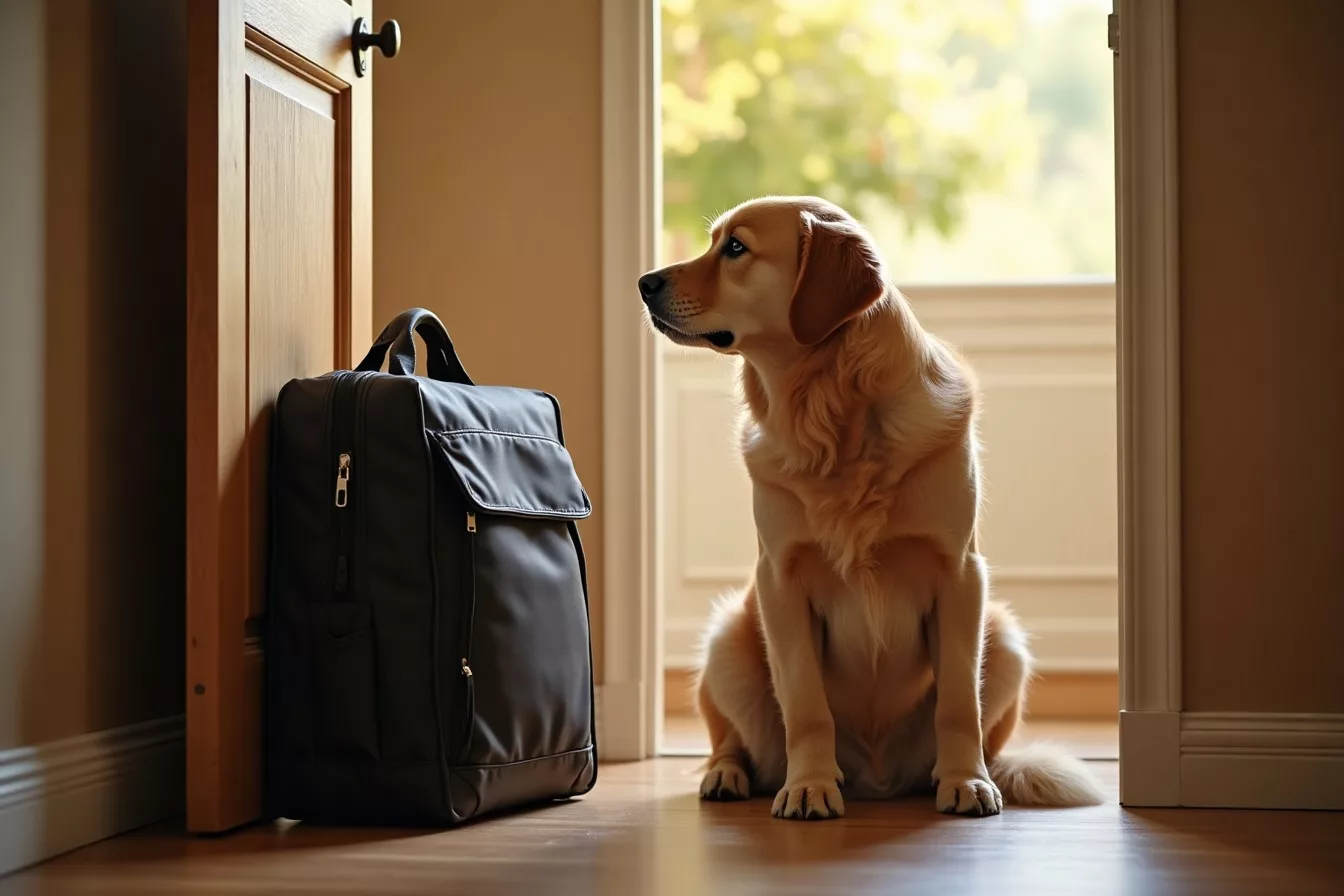

Your dog now panics when you head to the office. Your cat demands attention during video calls. A landmark 2025 study from the PDSA (People’s Dispensary for Sick Animals) has revealed that remote working has fundamentally reshaped pet behaviour in ways that may be permanent. In this article you’ll discover exactly what’s changed, why it happened, and—most importantly—what you can do about separation anxiety that’s now become your pet’s new normal. The surprising finding? 67% of pets show distress signals when their owners prepare to leave home, even after returning to the office.
📊 Key Figures 2026
- 67% of pets now display separation anxiety symptoms: Up from 43% in 2019, according to the PDSA Animal Wellbeing Report 2025
- 4 in 5 owners noticed behavioural changes: Destructive behaviour, excessive barking, and litter box issues spike when routines shift
- Dogs aged 3-7 are most affected: This cohort spent their formative years with constant human presence, creating dependency patterns
Sources: PDSA, British Veterinary Association (BVA), 2025
The Three-Year Bond That Changed Everything
From March 2020 onwards, millions of UK and US pet owners worked from home. For some, that lasted months. For others, it became three years of constant companionship. Pets—especially dogs and cats adopted or brought home during lockdown—never experienced their owners leaving for eight hours a day as “normal.” Their brains wired differently.
Dr. Emma Taylor, RSPCA Head of Companion Animals, has documented this shift: “We’re seeing a generation of pets that developed their entire social framework around continuous human presence. Now, as offices reopen and hybrid schedules emerge, those animals face genuine psychological distress.” The behaviour isn’t misbehaviour. It’s a genuine panic response.
What “Permanent” Really Means
The PDSA study tracked 3,000 UK households over 18 months. The finding that alarmed vets most: even pets whose owners returned to the office full-time did not naturally revert to pre-pandemic independence. Instead, anxiety behaviours—pacing, excessive vocalisation, soiling indoors—became entrenched.
One case stands out: Bella, a Cocker Spaniel from Bristol, was adopted in April 2020 when her owner worked remotely. By early 2024, when that owner returned to the office three days weekly, Bella developed destructive behaviour so severe she ate through drywall and required veterinary anti-anxiety medication. Her owner had to restructure her entire working life to accommodate the pet’s needs.
✅ Expert Tip
Start a “gradual absence routine” now. Leave your pet alone for just 15 minutes while you’re still home—sit in another room with the door closed. Reward calm behaviour with treats when you return. Increase intervals weekly. This mimics pre-pandemic independence without the shock of sudden full-day absence. Use puzzle feeders and scent items (worn clothing) to reduce anxiety during your absence.
The Hybrid Paradox
Interestingly, pets whose owners now work hybrid schedules (2-3 days in office) show *worse* anxiety than those with consistent full-time office schedules. Unpredictability is more stressful than absence. A pet learns to panic because it cannot predict when its owner will leave.
The solution lies in routine signalling. Owners who establish *consistent* preparation rituals—same departure time, same pre-departure activities—report 34% lower anxiety incidents. Your pet learns: 8:45 AM alarm = owner will leave at 9:00 AM. Predictability, paradoxically, reduces panic.
⚠️ Warning
If your pet shows signs of severe separation anxiety—continuous barking, self-injury, loss of appetite, or toileting indoors despite house-training—consult your vet immediately. Behavioural medication combined with structured retraining may be necessary. Do not assume the behaviour will resolve on its own; 58% of untreated cases worsen over six months.
What Cat Owners Are Missing
Cats have experienced an even stranger shift. Cats adopted post-2020 developed unusually strong attachment to their owners—behaviour normally reserved for dogs. As owners returned to offices, some cats developed excessive grooming behaviours and reduced appetite. The PDSA notes that indoor cats show this anxiety pattern far more than outdoor cats, simply because confinement + sudden absence = heightened stress.
The Path Forward
The word “permanent” in the PDSA study doesn’t mean irreversible. It means these behavioural patterns, once established, require intentional, structured intervention to address. You cannot simply expect your pet to “get over it.” Instead, retraining should begin immediately if you’re returning to the office.
Start with short absences. Introduce crate training or a designated safe space. Consider hiring a dog walker or pet sitter for midday breaks. Some owners have restructured careers entirely—others use medication as a bridge while behaviour modification takes root. There is no one solution, but there *is* a path.
The Bigger Picture
This 2025 PDSA study arrives at a critical moment. Remote work remains common but no longer universal. The pets most vulnerable—those aged 3-5 who spent formative years in isolation—are now maturing. The behaviours they’ve learned are becoming hardwired. But awareness is the first step. Vets report that pet owners who *understand* their animal’s anxiety is real (not spite, not punishment-worthy) are far more likely to seek constructive solutions.
Have you noticed your own dog or cat struggling with your return to the office? The kindest thing you can do is start small: leave for 10 minutes today, 15 next week, 30 the week after. Patience, routine, and professional support can rewire what the pandemic rewired in your pet’s mind.